
Superintelligence ASI Arrives Unevenly, Sorted by Grader Quality
Next Big Future · View original source
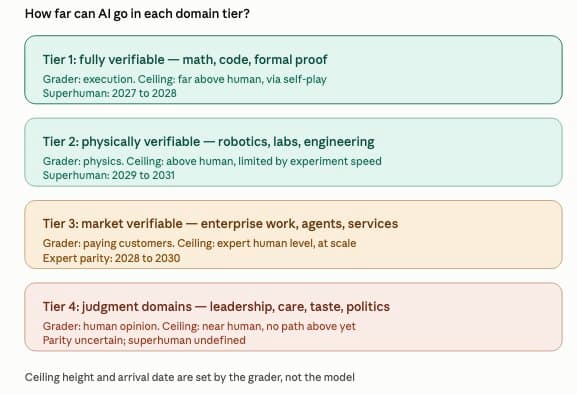
The emergence of superintelligent artificial systems is not a singular event but rather a gradual evolution that unfolds across various domains, dictated by the ease with which each domain's outputs can be verified. This nuanced understanding of superintelligence, particularly artificial superintelligence (ASI), highlights the importance of the grading mechanisms used to assess AI capabilities, which ultimately determine the pace and extent of advancements in different fields.
The Tiered Framework of Superintelligence
The concept of superintelligence is categorized into tiers based on the verifiability of tasks performed by AI. At the forefront is Tier 1, where advancements in ASI are expected to occur first. This tier encompasses AI research itself, which is pivotal because it allows for recursive improvement loops—cycles of enhancement that can occur rapidly in domains where the outcomes can be easily verified. For instance, algorithm design, chip layout, and training recipe searches are all activities that fall into this category, where improvements can be quantitatively assessed. The recursive nature of this improvement means that AI can leverage synthetic or self-play data to enhance its capabilities without reliance on human judges.
In contrast, Tier 4 represents domains where human judgment is the only available grading mechanism. Here, the potential for AI to achieve superhuman performance is significantly limited. Tasks that require subjective evaluation, such as understanding the needs of a grieving family or making strategic decisions, cannot be distilled into quantifiable metrics. Consequently, AI systems trained in these areas tend to converge towards the best human judgment available in their training data, creating a ceiling that is difficult to surpass. This limitation underscores the challenges faced in achieving superhuman capabilities in areas reliant on human opinion.
The Path to Superhuman Capabilities
Looking ahead, projections suggest that superhuman capabilities in mathematics and coding could emerge by 2027-2028, as outlined in the AI 2027 scenario. This forecast aligns with the understanding that automated AI research falls within the Tier 1 framework, making it a credible mechanism for accelerating advancements in intelligence. The expectation is that as AI systems become capable of outperforming human coders, an intelligence explosion could follow, driven by the rapid automation of research processes.
However, the potential for superhuman performance in other tiers is less certain. The AI 2027 scenario assumes that advancements in Tier 1 will seamlessly transfer to other domains, such as strategy and bioscience. Yet, the grading framework indicates that such transfers are costly and complex, suggesting that progress in these areas may lag behind Tier 1 advancements. For instance, Tier 2 requires physical experimentation and throughput that cannot be accelerated at the same pace as computational tasks. Similarly, Tier 3, which involves enterprise deployment, is constrained by longer cycles that are measured in sales quarters rather than weeks or months.
The economic implications of this tiered progression are significant. The order of impact follows the tier structure, as verifiability dictates both the speed of AI improvements and the confidence with which employers can deploy these technologies. Software development is anticipated to be the first labor market transformed, leading to a restructuring rather than outright elimination of jobs. The ratios of AI agents to engineers are expected to rise, compressing junior hiring roles while expanding the market for coding agents to a projected $25-$50 billion. Despite these shifts, overall productivity statistics may show minimal movement, illustrating a paradox where productivity gains are not immediately reflected in economic metrics.
Why it matters
The implications of this tiered approach to superintelligence extend beyond mere technological advancements; they pose profound questions for creators and technologists. The distinction between domains where AI can achieve superhuman capabilities and those where it cannot highlights the need for careful consideration of the grading mechanisms employed in AI training and evaluation. As AI systems become increasingly capable, understanding the limitations imposed by human judgment becomes crucial for guiding the development of ethical and effective AI technologies.
Moreover, the anticipated restructuring of labor markets raises concerns about the future of work. While AI may enhance productivity in certain sectors, it also risks creating wage compression and deskilling in occupations that rely on verifiable outputs. This dynamic could lead to a labor market characterized by a shortage of skilled workers in areas where human judgment remains irreplaceable, such as management and strategic decision-making, while simultaneously generating excess capacity in roles that AI can automate.
In conclusion, the journey toward superintelligent AI is complex and uneven, shaped by the verifiability of tasks across different domains. As we stand on the brink of significant advancements, the challenge remains to navigate the implications of these developments thoughtfully, ensuring that the benefits of AI are realized while mitigating potential risks to the workforce and society as a whole.
Frequently asked questions
- What is superintelligence?
- Superintelligence refers to an artificial intelligence that surpasses human intelligence across a wide range of domains, particularly in problem-solving and decision-making.
- What are the different tiers of AI capability?
- The tiers categorize AI capabilities based on how easily their outputs can be verified, with Tier 1 being the most verifiable and Tier 4 relying solely on human judgment.
- What economic impacts are expected from AI advancements?
- AI advancements are expected to restructure labor markets, particularly in software development, leading to changes in hiring practices and potential wage compression in certain roles.
Related stories
AI & art news in your inbox, daily
The day's top stories, summarized. Free, no spam, unsubscribe anytime.