
Graded AI Tasks and the Data Flywheel
Next Big Future · View original source
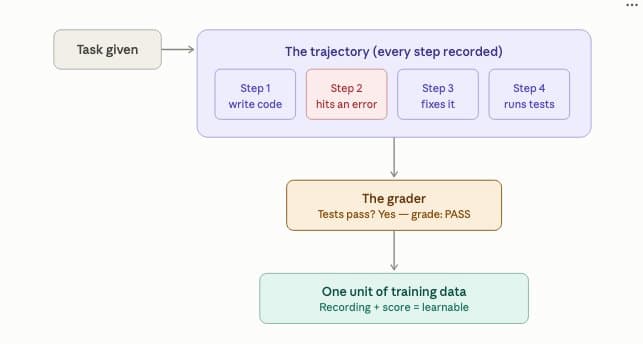
In the ever-evolving landscape of artificial intelligence (AI), the concept of graded trajectories has emerged as a pivotal element in the training and improvement of AI systems. A graded trajectory encompasses a comprehensive record of an AI's attempts at a specific task, paired with an evaluation of its success or failure. This duality forms the cornerstone of modern AI training data, enabling systems to learn and adapt effectively.
The significance of graded trajectories lies in their ability to provide a clear learning signal for AI models. By capturing every step taken by the AI—every decision made, every error encountered, and every correction applied—these recordings serve as detailed accounts of the learning process. This is akin to dashcam footage from a driving lesson, where the focus is not merely on the final outcome but on the entire journey that leads to that result.
The Role of Free Graders in AI Learning
A crucial component in the development of graded trajectories is the concept of a free grader. Free graders are mechanisms that automatically generate evaluations of AI attempts without incurring additional costs. They can take various forms, including passing tests, physical interactions with the environment, or customer feedback. The economic insight here is that the availability of free graders directly influences the volume of practice opportunities for AI models. Essentially, the more free graders available, the faster an AI can learn and improve its performance.
Three primary types of free graders exist: execution, physics, and markets. Execution graders evaluate whether the code runs successfully, while physics graders assess whether a physical task was completed correctly, such as a robot successfully picking up an object. Market graders, on the other hand, gauge success based on customer acceptance of the work performed. These free grading mechanisms are invaluable as they do not require human intervention; instead, they arise organically from the tasks being performed in real-world scenarios.
The interplay of these elements creates what is known as the data flywheel. This concept describes a self-reinforcing cycle where better AI models attract more users, which in turn generates more graded trajectories, leading to further model improvements. This cycle is strategically significant because, while the design of AI models can be replicated relatively quickly, the accumulation of graded real-world trajectories is unique and cannot be easily duplicated. As a result, companies are increasingly competing not just over algorithmic innovations but also over the ownership of environments where work occurs and the mechanisms that facilitate grading.
The Future of AI Grading Mechanisms
A notable example of this evolving landscape is the initiative known as Digital Optimus. This project aims to integrate a market grader into the Tesla-XAI stack, which currently lacks such a mechanism. By deploying screen agents into real workflows, Digital Optimus seeks to provide a grading system that evaluates whether tasks, such as ticket resolutions, are accepted by humans. This integration, alongside existing execution and physics graders, aims to create a comprehensive grading system that enhances the AI's learning capabilities.
Despite facing challenges in execution, the strategic coherence of this design highlights the importance of combining various grading mechanisms to optimize AI learning. The potential for Digital Optimus to facilitate a more robust grading system could significantly impact how AI models evolve and adapt in real-world applications.
As AI technology continues to advance, the understanding and implementation of graded trajectories and free graders will be crucial for developers and technologists. The ability to harness these concepts effectively will determine the pace at which AI systems can learn and improve, ultimately shaping the future of AI applications across various industries.
Why it matters
The implications of graded trajectories and free graders extend beyond technical advancements; they also influence the competitive dynamics within the AI industry. As companies vie for dominance, the focus shifts from merely developing algorithms to acquiring and maintaining access to environments that generate valuable graded trajectories. This shift emphasizes the importance of strategic positioning within the market, as organizations seek to establish themselves in areas that facilitate effective learning for AI systems.
For creators and technologists, understanding these mechanisms is essential for leveraging AI capabilities effectively. By recognizing the significance of graded trajectories and the role of free graders, developers can create more efficient and capable AI systems. As the landscape of AI continues to evolve, staying informed about these foundational concepts will be crucial for success in the field.
Frequently asked questions
- What is a graded trajectory?
- A graded trajectory is a complete recording of an AI's attempt at a task, along with a verdict on whether it succeeded or failed, forming a fundamental unit of training data.
- What are free graders?
- Free graders are mechanisms that automatically produce evaluations of AI attempts without incurring additional costs, such as execution, physics, and market graders.
- What is the data flywheel?
- The data flywheel is a self-reinforcing cycle where better AI models attract more users, leading to more graded trajectories and further improvements in the models.
Related stories
AI & art news in your inbox, daily
The day's top stories, summarized. Free, no spam, unsubscribe anytime.