
Chinese Firm UniX AI Launches Panther Humanoid Robot for Household Tasks
Naturalnews.com · View original source
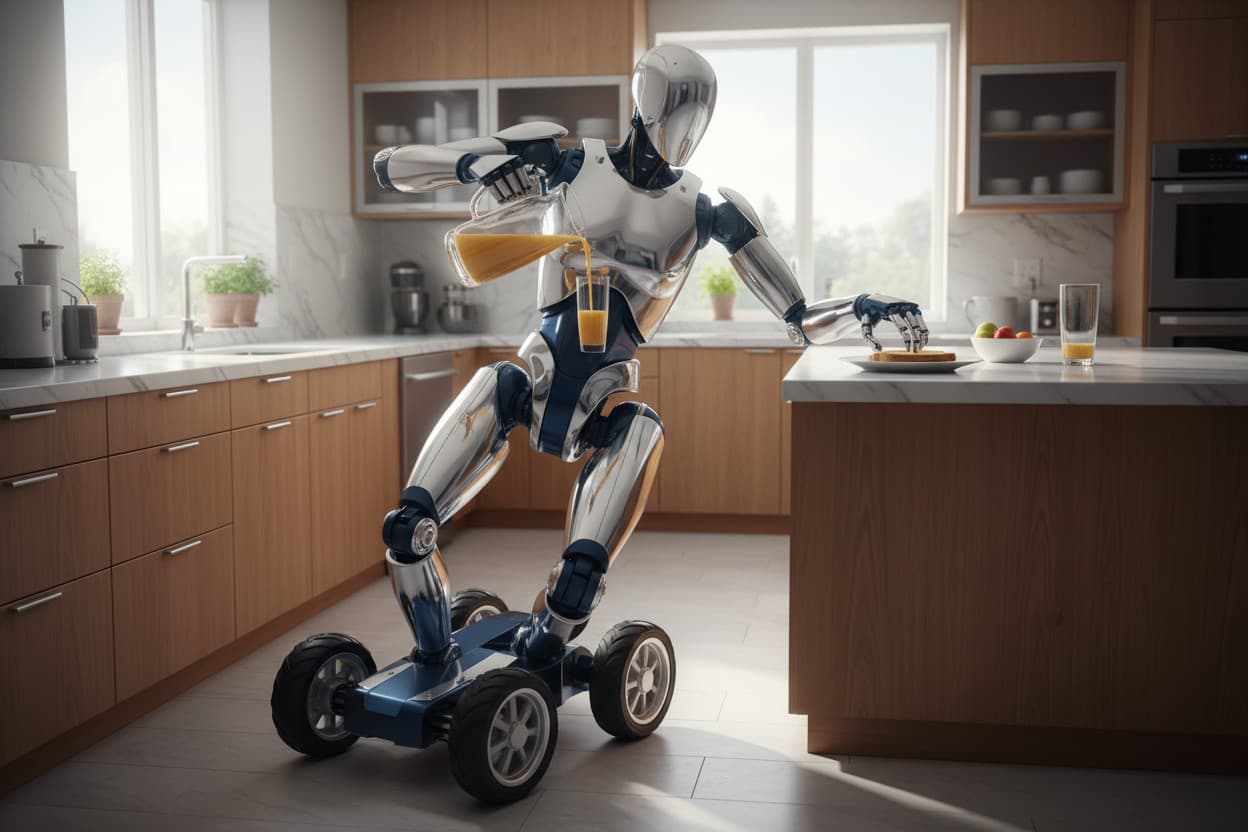
The Chinese robotics company UniX AI has officially commenced global deliveries of its Panther humanoid robot, which it claims is the world's first service humanoid robot designed for real household deployment. This significant milestone was announced on April 10, 2026, marking a pivotal moment in the evolution of domestic robotics. The Panther robot represents a third-generation, full-size wheeled humanoid, standing at approximately 5 feet 3 inches tall and weighing around 176 pounds (80 kilograms). Notably, the robot is capable of operating for 8 to 16 hours on a single charge, showcasing its potential for practical use in everyday household tasks.
Technical Specifications and Design Innovations
The Panther robot is distinguished by its unique omnidirectional, four-wheel-steering and four-wheel-drive (4WS+4WD) chassis. This design choice allows for agile movement and stable operation in complex indoor environments, diverging from the more traditional legged humanoid configurations seen in other robots. UniX AI asserts that this wheeled architecture, combined with advanced general-purpose AI models, enhances both efficiency and practicality for deployment in real-world settings.
Equipped with 34 high-degree-of-freedom joints, the Panther features what the company claims to be the world's first mass-produced 8-DoF (Degree-of-Freedom) bionic arms, along with adaptive intelligent grippers. These components are engineered for precise and flexible manipulation, enabling the robot to perform a variety of tasks with finesse. Additionally, the Panther is outfitted with cameras, sensors, and audio input systems that facilitate object recognition, indoor navigation, and human interaction, making it a versatile tool for household management.
The design philosophy behind the Panther emphasizes the use of a team of networked, task-specific agents tailored for home environments, rather than relying on a single multi-tasking robot. This approach aligns with previous robotics research and reflects a growing understanding of how robots can be effectively integrated into daily life.
Demonstrated Capabilities and Challenges
In practical demonstrations, the Panther robot has successfully executed multi-step domestic task sequences, which include waking users, preparing breakfast, cleaning rooms, organizing household items, and operating various appliances. The system is designed to manage complete workflows, such as preparing a meal and subsequently cleaning the kitchen. This capability represents a significant advancement toward robots that can handle coordinated, multi-step operations in dynamic home environments, a task that has historically posed substantial programming challenges.
Despite these advancements, experts caution that no humanoid robot has yet demonstrated the ability to autonomously complete complex chores such as laundry, which requires sorting, washing, drying, and folding. This highlights ongoing challenges in the field of household robotics, including the need for reliable navigation in cluttered spaces, adaptability to varying lighting conditions, and the ability to interact with a diverse array of household appliances.
Company Vision and Future Applications
Fred Yang, the Founder and CEO of UniX AI, expressed confidence in the company's progress, stating that their platform has evolved from lab validation to mass delivery and from local deployment to global expansion. The Panther robot is designed for a wide range of applications beyond home use, including commercial services in hotels and retail, as well as roles in public and industrial sectors like security patrols and research.
The introduction of the Panther occurs within a rapidly growing global robotics market, which is increasingly shifting focus from industrial applications to domestic robotics. Industry analysts note that the performance of robots in various domestic tasks indicates a gradual approach toward fully functional home assistants, despite the remaining hurdles.
Furthermore, China's recent establishment of its first comprehensive national standard framework for humanoid robots aims to support large-scale commercialization, underscoring the country's intent to lead in the global robotics race.
Conclusion
The launch of UniX AI's Panther robot signifies a critical step in the ongoing development and commercialization of humanoid robots for domestic and service applications. As global deliveries commence, this development marks a transition from theoretical research to practical deployment in the consumer market. The competitive landscape includes other companies, such as 1X Technologies and U.S.-based Figure, which are also advancing their own humanoid robots for home use. As the industry evolves, it faces critical questions regarding the impact of these technologies on job markets, social dynamics, and personal privacy, all of which will require careful consideration as the field progresses.
Frequently asked questions
- What is the Panther robot?
- The Panther robot is a humanoid robot developed by UniX AI, designed for household tasks and capable of operating for 8 to 16 hours on a single charge.
- What are the key features of the Panther robot?
- Key features include a wheeled design for agile movement, 34 high-degree-of-freedom joints, and advanced sensors for object recognition and navigation.
- What challenges do humanoid robots like Panther face?
- Humanoid robots face challenges such as navigating cluttered environments, interacting with various household appliances, and performing complex tasks autonomously.
Related stories
AI & art news in your inbox, daily
The day's top stories, summarized. Free, no spam, unsubscribe anytime.